Home › Guides › Restaurant fire suppression in Florida
Restaurant fire suppression in Florida: install and service
- Pick what you need and give your kitchen's ZIP code.
- Each service goes to the number of local companies you choose, from one to five. We check licenses where the law requires one and email you their names.
- You talk with them and decide. You hire and pay the company directly.
Facts checked 2026-11-02.
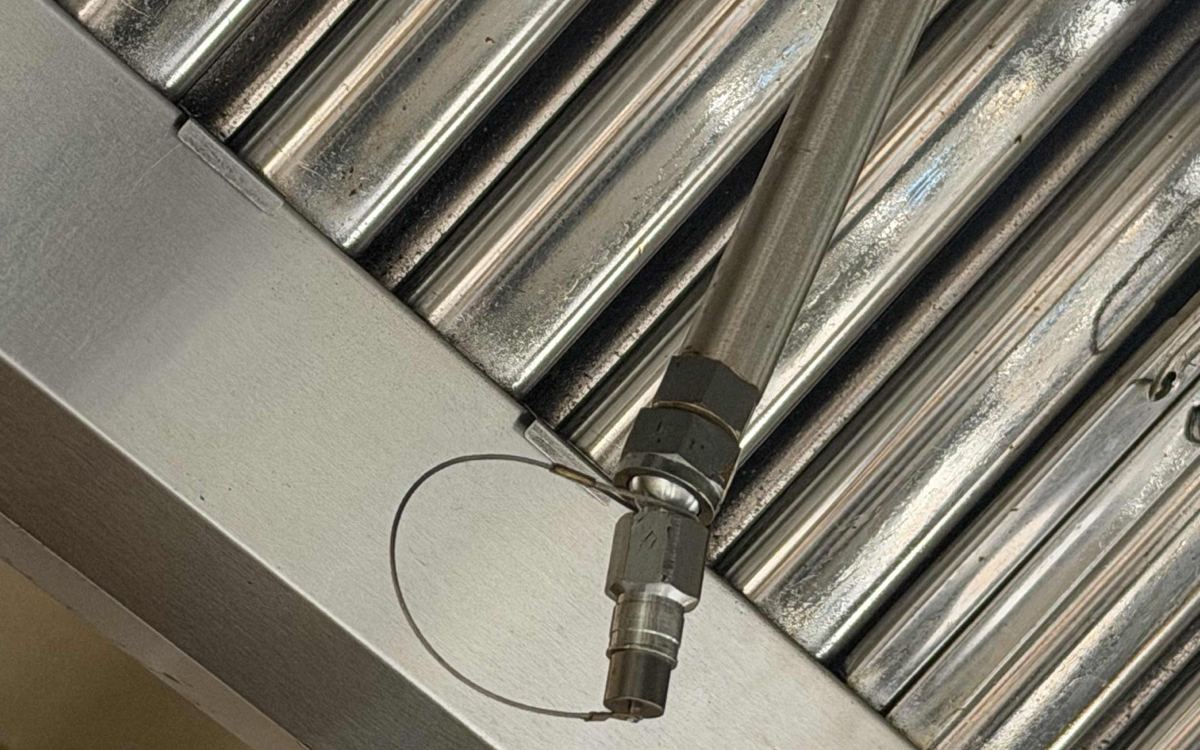
A restaurant fire suppression system is a built-in set of nozzles over the cooking line that sprays a wet chemical when a fire starts. In Florida the system has to be installed and serviced by a company licensed by the State Fire Marshal. The local fire marshal checks the tag, and the usual service interval is every six months.
What the code requires
The Florida Building Code requires an approved automatic fire suppression system for appliances that need a Type I hood. That covers fryers, griddles, ranges and charbroilers that make grease or smoke. See hoods and exhaust for the hood side.
Most restaurants use a pre-engineered system. Florida law defines it as a system listed by a nationally recognized testing laboratory, and installed within the limits the maker tested it to and the NFPA standards.
The Florida Building Code, Building, adds these details:
- The system is tested to UL 300, the standard for fire testing of kitchen suppression systems, and is listed and labeled.
- A manual pull station sits at or near an exit from the cooking area. It is 10 to 20 feet from the exhaust system and 42 to 48 inches above the floor, and it takes no more than 40 pounds of force to operate.
- When the system fires, it shuts off the fuel or electric power to the cooking equipment. A person has to reset it by hand.
Florida's fire code adopts NFPA 17A (2021) for pre-engineered wet chemical systems and NFPA 17 (2021) for dry chemical systems. Your fire marshal enforces the edition in force locally.
Installing a system
A new install comes with a drawing, and the licensed company's first report records the system type, maker, model and bottle size. Ask your local fire marshal what it wants to see before final approval.
A pre-engineered system is designed for the appliances under the hood. If you add a fryer, swap a griddle for a charbroiler or move the line, ask the licensed company to check the layout before the change. Only a licensed company may do that work.
A local company can take it from here. One form, free for restaurants.
Get connectedService every six months
The usual expectation is service twice a year. A Florida county fire checklist, for example, asks for a valid service tag that is within the last six months. Florida's rules for fire equipment dealers list "semi-annual" as one of the report types a dealer files for a pre-engineered system.
Under Florida Administrative Code Rule 69A-21:
- Each serviced system gets a standard service tag showing the company name and the technician's permit number.
- Every install, inspection and service gets a report. It records the system type, maker, model, bottle size, the last hydrostatic test and recharge dates, and whether the fuel shutoff works. New installs include a drawing.
- The owner gets one signed copy. The dealer keeps one for at least three years.
Keep the copies. An inspector or an insurer can ask for them.
Between services, guidance from other state health departments that follow older NFPA editions says trained staff can do a monthly check of the system. Ask your fire marshal whether the Florida edition has the same expectation.
Who may do the work
Florida law (section 633.304) requires a State Fire Marshal license to service, repair, recharge, test, inspect or install fire extinguishers and pre-engineered systems. The license classes are:
| Class | Covers |
|---|---|
| Class A | All fire extinguishers, including hydrostatic testing of all types |
| Class B | Extinguishers, hydrostatic testing excluding CO2 |
| Class C | Extinguishers, excluding CO2 recharge and CO2 hydrostatic testing |
| Class D | Pre-engineered systems, which includes restaurant hood systems |
Each business location needs its own license, and each individual doing the work needs a permit. The technician carries the permit and a photo ID and shows them on request. A trainee works only when a permit holder is physically present, and one trainer can supervise no more than two trainees.
Licenses and permits expire on December 31 of odd-numbered years, and renewal takes 16 hours of continuing education.
How to check a company
- Ask for the Class D license number (or an A, B or C class if it also services extinguishers) and the technician's permit number.
- Check the number with the State Fire Marshal's licensing office. The Division of State Fire Marshal lists its licensing contact at (850) 413-3171 or [email protected].
- Look at the tag the company leaves. It should show the company name and the permit number.
- Ask for the report after each visit.
- Check how the company advertises. Florida law makes it a crime to do contracting work or advertise it without a license, and falsely holding out as able to do work beyond a license is unlawful.
Inspections by fire chiefs, fire inspectors, fire marshals and insurance inspectors are outside the licensing section. Their staff do not need a Class D license to inspect.
Add your kitchen's ZIP code to the form for suppression service or a new install, and one licensed local company gets the request.
Questions
How often does a restaurant fire suppression system need service?
Usually twice a year. A Florida county fire checklist asks for a tag dated within the last six months. Your local fire marshal's office has the final say.
What license does a company need to install a restaurant hood system in Florida?
A Class D license from the State Fire Marshal for pre-engineered systems, plus a permit for each technician. Each business location needs its own license.
What is UL 300 for a restaurant fire suppression system?
UL 300 is the fire test standard for kitchen suppression systems. The Florida Building Code asks for restaurant hood systems that are tested to it and listed and labeled.
Do I need to change my fire suppression system if I move kitchen equipment?
Ask the licensed company before you move anything. A pre-engineered system is installed within the limits it was tested for, and the nozzles are matched to the appliances under the hood.
Sources
- Florida Statutes 633.304, fire equipment licenses
- Florida Statutes 633.102, definitions
- Chapter 69A-21, Florida Administrative Code (State Fire Marshal PDF)
- Rule 69A-3.012, adopted NFPA editions
- Florida Building Code, Building, chapter 9 (UpCodes copy)
- State Fire Marshal, regulatory licensing
- Florida Statutes 489.127, unlicensed contracting
- Charlotte County Fire/EMS pre-inspection checklist
- Minnesota Department of Health, protection of kitchen cooking equipment