Home › Guides › Commercial kitchen hoods in Florida
Commercial kitchen hoods in Florida: what the code says
- Pick what you need and give your kitchen's ZIP code.
- Each service goes to the number of local companies you choose, from one to five. We check licenses where the law requires one and email you their names.
- You talk with them and decide. You hire and pay the company directly.
Facts checked 2026-11-02.
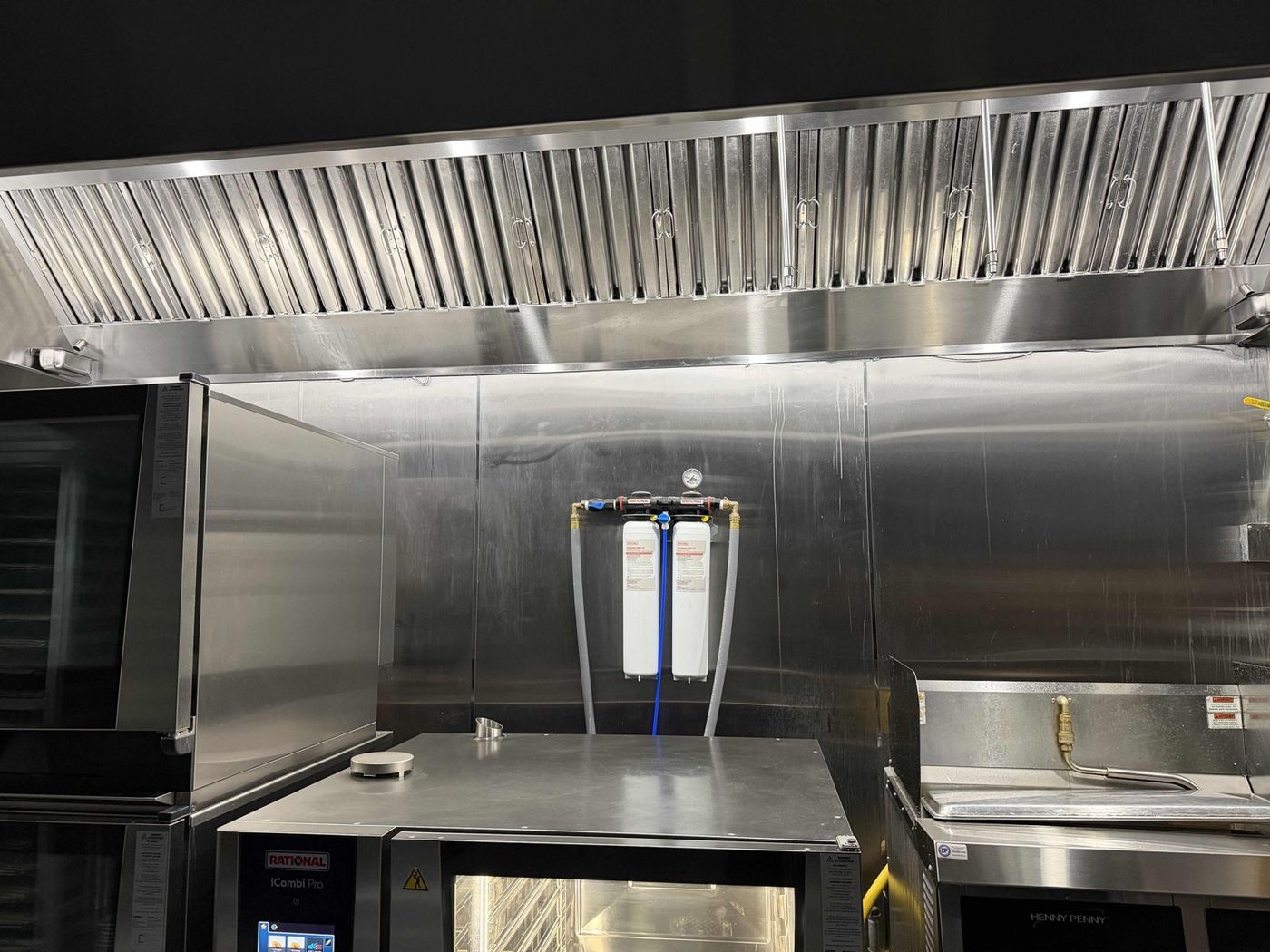
A commercial kitchen hood works as part of a system. Under the Florida Building Code the hood, the grease duct, the exhaust fan and the makeup air all have to work together, and the whole system is tested before final approval. Your building department and fire marshal decide what they accept for your building.
Type I and Type II hoods
The Florida Building Code, Mechanical, uses two hood types.
- Type I hoods go over cooking that makes grease or smoke: fryers, griddles, charbroilers, ranges. Where a Type I hood is installed, the hood, duct, exhaust equipment and makeup air all have to follow the same code sections.
- Type II hoods go over dishwashers and other equipment that makes heat or moisture but not grease or smoke.
Two exceptions to the Type I rule appear in the code: electric appliances that pass the UL 710B test for low grease output, and listed solid-fuel pizza ovens with direct venting.
A Type I hood carries a label with its minimum exhaust rate in cubic feet per minute per linear foot. The hood must be steel of at least No. 18 gage, or stainless steel of at least No. 20, with outside seams welded liquid-tight. Grease filters are listed to UL 1046.
How much air the hood must move
The exhaust rate depends on how heavy the cooking is and where the hood sits. These are the code's cfm per linear foot of hood:
| Cooking duty | Wall-mounted canopy | Single island canopy |
|---|---|---|
| Extra-heavy | 550 | 700 |
| Heavy | 400 | 600 |
| Medium | 300 | 500 |
| Light | 200 | 400 |
If different appliances sit under one hood, the heaviest duty sets the rate. The code sorts appliances into these duty classes. Your mechanical engineer or hood supplier works out where each appliance falls.
A local company can take it from here. One form, free for restaurants.
Get connectedGrease ducts
The grease duct carries grease-laden air from the hood to the roof, and the code is strict about it because a fire in a duct spreads quickly.
- The duct is steel of at least No. 16 gage, or stainless steel of at least No. 18.
- Joints are welded or brazed liquid-tight on the outside. The code calls for a light test with a lamp of at least 100 watts.
- The duct keeps 18 inches from combustible construction.
- Cleanouts sit no more than 20 feet apart and within 10 feet of direction changes over 45 degrees. Access doors are steel and liquid-tight. They carry a sign that reads "ACCESS PANEL. DO NOT OBSTRUCT."
- A duct that passes through a ceiling, wall, floor or concealed space is enclosed, with a fire rating of at least one hour that matches the floor or wall it passes through. No fire or smoke dampers go in a grease duct.
- At the roof the discharge is at least 40 inches above the roof surface and 10 feet from property lines and 10 feet above grade.
Cleaners reach the duct through those cleanouts. See hood cleaning for how often the system is inspected and when a cleaning follows.
Fans
Rooftop fans on a grease system are the "upblast" type. The code asks for fans that are hinged and restrained with a flexible, weatherproof cable. The duct rises at least 18 inches above the roof under the fan.
Makeup air and air balance
Air that leaves through the hood must come back in. The code asks that makeup air from all sources be about equal to the exhaust. Mechanical makeup air has to start and run with the exhaust fan. The temperature difference between makeup air and the room should be no more than 10 degrees Fahrenheit, with an exception in the code. Design plans include an outdoor air balance schedule or diagram.
Ask the installer for the air balance schedule that goes with the design plans.
Fire suppression and the hood
The code requires an approved automatic fire suppression system for any appliance that needs a Type I hood. The system's actuation also shuts off the fuel or electric power to the cooking equipment. See fire suppression systems.
The final test
Before final approval the code calls for a performance test of the hood system. It covers the exhaust airflow, the makeup airflow and whether the system works as designed. Capture and containment are verified with smoke or steam.
Taking over an older location
Do not assume a hood that was approved years ago is still good. When you take over a kitchen, ask for:
- The last hood cleaning certificate and the service report.
- The last six-month tag on the fire suppression system.
- Any permit and plans for the hood.
- A look at the duct cleanouts. Make sure the access panels are there and not blocked.
If you plan to add a fryer or move a line of equipment, the hood and suppression system often need changes too. A pre-engineered suppression system is installed within the limits it was tested for, so ask the licensed company to confirm the layout before you move equipment. Ask your building department whether the change needs a new permit.
Who is licensed to do the work
Florida licenses mechanical and sheet metal contractors under chapter 489. Which contractor license your permit office accepts for a hood and grease duct varies, so ask the building department before you hire. The fire suppression part is separate and needs a State Fire Marshal license. It is a crime in Florida to do contracting work, or advertise it, without the right license. You can look up any contractor on the DBPR license search.
Hood, duct and exhaust fan requests sent through the form go to the number of local companies you choose (one to five).
Questions
Do I need a Type I hood for every kitchen?
You need one over cooking that makes grease or smoke. Dishwashers and heat or moisture equipment can use a Type II hood. The code lists a few exceptions, such as low-grease electric appliances that pass the UL 710B test.
How tall must the exhaust fan be above the roof?
The grease duct discharge must be at least 40 inches above the roof surface. The upblast fan duct sits at least 18 inches above the roof. Your building department can confirm what it enforces.
Who tests a restaurant hood system before opening?
The Florida Mechanical Code requires a performance test before final approval. It checks exhaust airflow, makeup airflow and smoke capture. Ask your building department who it accepts to perform it.
Where do I look up a hood contractor's license in Florida?
Use the DBPR license search at myfloridalicense.com. Fire suppression companies are licensed separately by the State Fire Marshal.